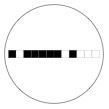
I suppose it is true that (western) musical harmony corresponds to a kind of ternary computing. The binary numbers correspond to octaves: powers of 2. The circle of fifths represents the presence or absence of a power of 3. Groupings of bits over these fifths create a combination of relative consonance and potential further resolution.
Tag Archives: theory
Flocking bits
I think of all this as a sensible introduction to non-binary computing. It is more than just interesting that: 1) a musical, number-theoretical treatment of groups of bits can contain such a vast amount of harmonic information of a more or less intuitive (Jazz-related) type; 2) the problem of indefinite location/identification appears as a problem […]
Doing
Watching people learn instruments, it is hard not to wonder whether some of the beauty of playing lies in the simple fact of its being done — a fact wildly underrepresented in digital music. There is in digital music the fact of things being conceived. But moment-for-moment facts, unpaste-able, in real contact, making sensual sense, […]
Canteloupe
Before starting, it is probably important to stress how much making music is like hitting a canteloupe. It is a way of guessing at the content of the invisible inside — much like setting elements on fire to see their spectrum. For this reason, it is probably best to work at bit-level with a computer. […]
Neural
The peculiar thing is that harmony can be represented as a very, very small neural network based on the reconstruction of prime-numbered groups of bits.
Rhyme
Online, there is a contest between rhyme and reason. Rhyme is winning, and causing falsehoods to spread.
Kolkata
Making noise online is like honking in the Kolkata (Calcutta) traffic. Not to warn others that you are there, but to prove to yourself that you exist.