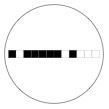
could be a worthwhile slogan.
Canteloupe
Before starting, it is probably important to stress how much making music is like hitting a canteloupe. It is a way of guessing at the content of the invisible inside — much like setting elements on fire to see their spectrum.
For this reason, it is probably best to work at bit-level with a computer. Everything else will just be addiction, not investigation of things.
Though I suppose there is much to be said for the power of addiction.
Figured Bass
On a small neural-network-like basis, it is possible to write a very precise kind of figured bass. The computer itself can improvise upon it, using a very limited number of input parameters (5 parameters which can be further compressed as a 16-bit byte for transmission).
Usefully, in this scheme, each note is not a point but a vector. And each chord is not pinned down, but shown to be one of a limited number of locations. Choosing one of these allows improvisation in the surrounding mode.
Also usefully: melody and harmony have the same representation.
Neural
The peculiar thing is that harmony can be represented as a very, very small neural network based on the reconstruction of prime-numbered groups of bits.
Rectangles
The problem, from a computational perspective, is how to make music — or music notation, at least — rectangular. A problem of measurable dimensions.
It’s not really possible, but it’s more possible than current systems allow.
After that, it can be confronted like chess or go.
Rhyme
Online, there is a contest between rhyme and reason. Rhyme is winning, and causing falsehoods to spread.
Kolkata
Making noise online is like honking in the Kolkata (Calcutta) traffic. Not to warn others that you are there, but to prove to yourself that you exist.
Music and the idea of the invisible thing.
What I wish to keep track of is the meaning of music in digital media.
The idea of what people are — indeed the idea of what things are — is shifting with media. We have long conceived who we were through print, paint, recordings, and other strange mirrors. And now data is our mirror, our representation. Big data is our house of mirrors. Where we had once squeezed expression from single dimensions — vanishing points, letters, or notes, we now must also derive it from masses of bits, each one a vanishing point. And so we live between the minimal and the maximal, hoping to derive meaning by drawing paths between these points, like constellations.
What music offers is something pre-representational. It gives us an idea of how ideas are formed, of how the invisible can still be conceived, and above all how they an be remembered.
But even the invisible is shifting with our new forms of representation. And that will be the subject of this writing.
Hello world!
Welcome to WordPress. This is your first post. Edit or delete it, then start writing!